


Menu
By theme
By theme





{{ variable.name }} : {{ variable.values[selectedVariantsIndex[variable_index]].name }}
Quantity:
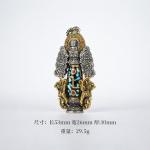
A dZi is a Tibetan bead, and nine-eye is one of its patterns: nine eyes spaced around the body with zigzag lines between them. A true dZi is agate. This one is white copper in the form of a dZi, not an agate bead, and the price sits a different order of magnitude away. The nine eyes run in a line and the zigzags read like a ridge; the body narrows at both ends and swells slightly in the middle. The hole runs end to end, so stringing is easy, and the eye spacing should be even. The turns of the zigzag should finish cleanly, and the gaps left between elements are not wide.
There are many accounts of where the dZi came from: some say India, some say local craft, and scholarship has not settled it. Folk belief in Tibet holds them high, as treasure fallen from the sky. That belongs to belief rather than to evidence. When someone talks about dZi, sort out first which sentence is legend and which is sales talk. Connoisseurs look at the material and the weathering, and a copper piece has neither. The name carries weight, and imitations are many. In Tibet a dZi can go into medicine, or be offered before an image.
On a copper nine-eye the pattern depends on casting and chasing, and the roundness of the eyes and the regularity of the zigzags are where the work shows. White copper is not coloured, so the eye pattern is separated by height and by light rather than by the natural black-and-white contrast of agate, and at a distance it reads a layer flatter. Cast a zigzag crooked and the nine eyes follow it off true. The spacing has to be even, since even spacing is what keeps it from looking crowded, and that is the most painstaking part of the copper work. Copper is not glazed; the colour is the alloy's own.
The hole is straight and takes cord or chain, and the pendant is small, worn at the chest. A copper nine-eye is not good strung together with agate and jade, since the difference in hardness is too great and they grind each other. If you do string them, put a soft spacer between. Rounding the mouth of the hole at both ends keeps the cord from breaking. A nine-eye fears knocks from hard objects, so bag it on its own when it is off. Spacers in a string cut down the wear.
White copper in its own colour, dulling with time, the hollows of the eye pattern darkening first, so dry brushing is the main method. Do not use silver cloth, which takes the dark out of the hollows and leaves the pattern faint. It contains nickel, so sensitive skin should take note. Do not use toothpaste either: the copper brightens fast and the pattern goes pale with it. An imitation sells the form, not the material, so be clear about that before buying. A copper bead is light and no burden to wear.